Steel Castings

Delivering steel casting excellence through technology and know-how

BRC supplies steel castings with reliable performance in energy and other industrial applications.

Our Production Capabilities

Simulation

Simulation

BRC’s mould design process integrates advanced engineering software, including SolidCAST/MAGMA simulation and SolidWorks CAD/CAM modelling. These tools enable the analysis of metal flow and solidification before production.

By validating designs virtually, we reduce trial-and-error, shorten lead times, and improve first-pour success rates.

Pattern Making

Pattern Making

Once the design is validated through CAD modelling and simulation, BRC proceeds with pattern production. Patterns are manufactured using CNC machining and high-quality materials to accurately replicate the final casting geometry and form the mould cavity.

For complex mould designs, we also utilise in-house 3D printing capabilities.

Moulding

Moulding

With completed patterns, the moulding process begins. Mould cavities are formed using sand moulding and core-making technologies selected according to casting size, geometry, and complexity.

Melting and Pouring

Melting and Pouring

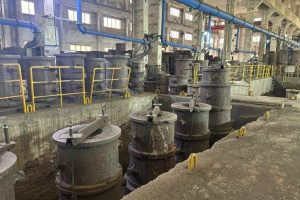
BRC applies controlled melting and pouring processes to support consistent steel quality.

  • Large Castings: With an annual melting capacity of 130,000 tonnes, BRC operates advanced melting and refining systems to ensure clean and consistent molten steel.
  • Small Castings: BRC also maintains dedicated facilities for small steel castings, with an annual melting capacity of 10,000 tonnes and individual casting weights of up to 5 tonnes. Components with maximum dimensions of 4.5m x 2.4m x 1.0m are produced while maintaining strict control over dimensional accuracy and metallurgical quality.
Main Equipment of Castings Production Line
Equipment Name Processing Capacity
Induction Furnace 20m x 70m x 50m (L x B x H)
Electric Arc Furnace 45t
Ladle Refining Furnace 120t-140t
VD/VOD Furnace 120t
Shakeout and Sand Reclamation

Shakeout and Sand Reclamation

After cooling and solidification, castings undergo shakeout, where sand, runners, and risers are removed using controlled vibration systems.

Used sand is processed through reclamation units before being returned to the sand mixer, where binders and additives are introduced to prepare moulding sand for reuse.

Heat Treatment

Heat Treatment

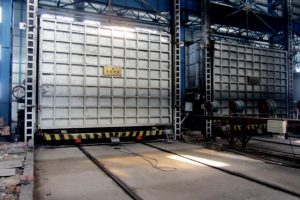
To achieve the desired mechanical properties, BRC’s castings undergo carefully controlled heat treatment cycles. These processes refine the material’s microstructure and enhance the overall durability of each component.

Treatment schedules are tailored to the specific alloy and application, ensuring dependability under the most demanding operating conditions.

Main Equipment of Castings Production Line
Equipment Name Processing Capacity (L x B x H)
Heat Treatment Furnace 10m x 13m x 6m
13m x 9m x 6m
12m x 8m x 6m
Inspection, Excavating, and Grinding

Inspection, Excavating, and Grinding

Every steel casting is subject to comprehensive inspection and testing protocols. Non-destructive testing (NDT) methods, including ultrasonic, magnetic particle, radiographic, and penetrant inspections, verify the material’s integrity. Dimensional checks ensure conformance with specifications, while mechanical testing, such as tensile, impact, and hardness assessments, confirm performance characteristics.

All testing and reviews are carried out by certified Level II and Level III NDT inspectors, ensuring the highest level of accuracy and compliance. Processes are conducted in line with international standards and certifications, including ABS, DNV, Lloyd’s Register, and ISO.

Following inspection, castings proceed to excavating and grinding, where surface irregularities are removed, and the final geometry and finish are achieved.

Welding and Fettling

Welding and Fettling

Where required, welding repairs are carried out based on inspection results. Welding processes include:

  • Shielded Metal Arc Welding (SMAW)
  • Tungsten Inert Gas (TIG)
  • Gas Shielded Arc Welding (GSAW)
  • Flux-cored Arc Welding (FCAW).

Fettling operations are then performed to smooth weld areas and refine surface finishes.

Machining

Machining

BRC provides both rough and finish machining for steel castings. With CNC lathes, horizontal and vertical lathes, and advanced milling machines, we can handle components up to 8 metres in dimension and weighing up to 80 tonnes.

This combination of capacity and precision enables us to deliver quality castings that meet the most stringent requirements.

Main Equipment of Machining Centre
Equipment Name Processing Capacity
Vertical Boring Mill 2.5m to 10.0m
Vertical Lathe Up to 10m
CNC Moving Beam Boring and Milling Machine 5m x 16m
CNC Gantry Boring and Milling Machine 6m x 12m
6920 Series Double-column Mobile Boring and Milling Machine Max Part Size (L x B x H): 16.0m x 5.2m x 3.5m
Max Part Weight: 200t
CNC Planer Type Milling Machine 5.0m x 16.0m
2.5m x 6.0m

Find the perfect solution for your plant’s needs - explore our full range of casting solutions customised to your specific requirements.